We often think of the Regency period as an age of elegance, letters, and social intrigue — but it was also a time of remarkable curiosity and discovery. One particularly charming example of this is the spyglass — a small, handheld telescope that turned up in everything from scientific pursuits to seaside flirtations.
Whether tucked discreetly into a lady’s reticule or fastened to a gentleman’s belt, the spyglass was a staple accessory for the inquisitive soul.
What Exactly Was a Spyglass?
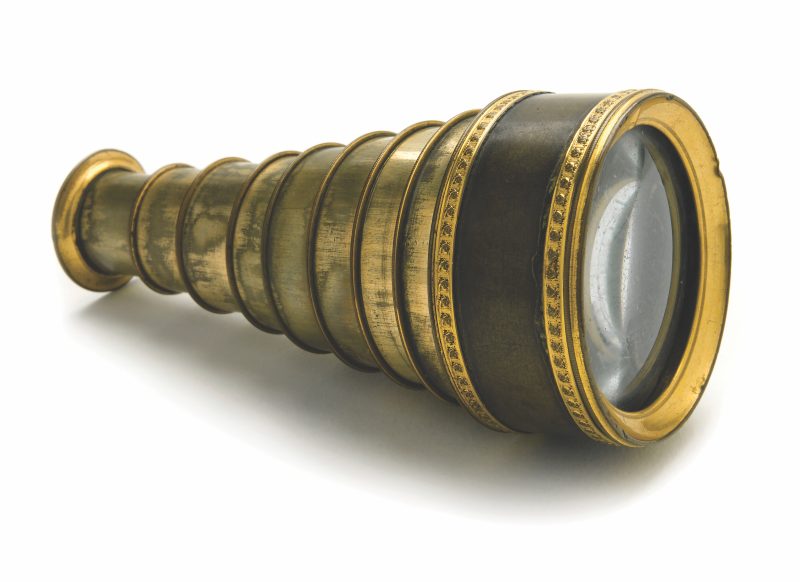
Spyglasses were typically made of brass, often with leather accents or engraved detailing, and many had a collapsible design — ideal for tucking away after a bit of stargazing or social surveillance.
At its core, a spyglass was a simple but elegant optical tool: a series of magnifying lenses aligned to bring distant scenes sharply into focus. Depending on the quality (and price), they offered varying degrees of clarity. The best models boasted polished lenses that delivered remarkably crisp views — making them prized possessions among the fashionable and the forward-thinking alike.
Practical Uses… and a Few Less-Than-Noble Ones
While spyglasses were certainly practical — used for surveying landscapes, watching ships come into harbour, or even following the progress of a battle — they weren’t always employed in such noble pursuits.
It was not entirely uncommon for a Regency gentleman to lift a spyglass at a ball, ostensibly to admire the architecture, but in truth to better observe a certain lady’s dancing. And a few sharp-eyed matrons may have turned theirs toward the neighbouring estate to see just who was calling on whom.
A Symbol of Status and Curiosity
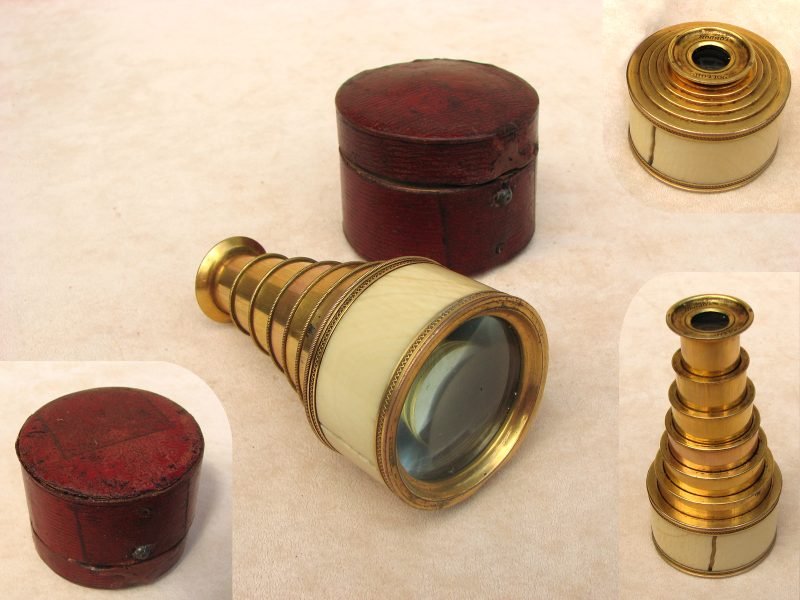
Like so many accessories of the era, the spyglass also served as a statement piece. It hinted at one’s education, curiosity, and engagement with the wider world. Possessing a spyglass suggested that you were a person who paid attention — whether to the stars above, the ships at sea, or the whispers in the drawing room.
Artists even included them in portraits, often placed just-so on a table beside a globe or a stack of well-worn books — further evidence of the owner’s worldly wisdom.
Legacy and Lasting Charm
While the traditional spyglass has mostly been replaced by binoculars and modern telescopes, its spirit lives on. It was, in many ways, the Regency equivalent of carrying a pair of sharp eyes and a questioning mind in one’s pocket.
In Conclusion
The Regency-era spyglass was far more than a tool for peering at distant objects. It was a symbol of exploration, intellect, and — let’s be honest — a little social mischief. Equal parts science and style, it offered a glimpse not only into the world beyond, but also into the curious minds of those who carried it.
References for Further Reading:
- History of the Telescope
https://en.wikipedia.org/wiki/History_of_the_telescope - The Telescope’s Influence in Colonial America
https://www.samsonhistorical.com/blogs/reliving-history/the-telescopes-influence-in-colonial-america

Leave a Reply