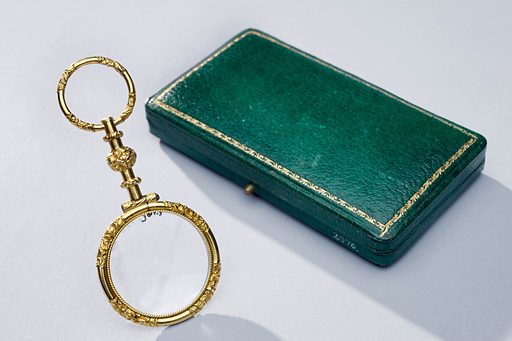
In the Regency era, the quizzing glass was a popular accessory among the elite, serving both as a fashion statement and a practical tool. This small, handheld monocle was used to examine objects or people more closely, but it also became a symbol of sophistication and social status. The quizzing glass was an essential part of a Regency gentleman’s or lady’s ensemble, reflecting the era’s emphasis on elegance and refinement.
The Design and Use of the Quizzing Glass
A quizzing glass typically consisted of a single lens mounted in a frame, often made of gold, silver, or another precious metal. The lens was attached to a chain or ribbon, allowing it to be worn around the neck or tucked into a pocket. Some quizzing glasses were elaborately decorated with engravings, gemstones, or intricate designs, making them as much a piece of jewellery as a functional object.
The primary use of the quizzing glass was to magnify objects, making it easier to read small print or examine fine details. However, it also became a tool for social interaction. A well-timed raise of the quizzing glass could convey curiosity, scepticism, or even disdain, adding a layer of nonverbal communication to Regency etiquette.
The Social Significance of the Quizzing Glass
The quizzing glass was a symbol of wealth and sophistication, as only the elite could afford such finely crafted accessories. It was often used to signal one’s social standing, with the manner in which it was wielded conveying subtle messages about the user’s confidence and taste. For example, a languid raise of the quizzing glass might indicate boredom or superiority, while a quick glance could suggest interest or approval.
The quizzing glass also played a role in courtship and flirtation. A lady might use it to discreetly observe a potential suitor, while a gentleman could employ it to admire a lady’s beauty from a distance. In this way, the quizzing glass became a tool for navigating the complex social rituals of the Regency era.
The Decline of the Quizzing Glass
By the mid-19th century, the quizzing glass had largely fallen out of fashion, replaced by more practical and less ostentatious forms of eyewear. However, its legacy endures in the continued appreciation for elegant accessories and the art of nonverbal communication.
Conclusion
The Regency quizzing glass was more than just a functional tool; it was a symbol of elegance, refinement, and social acumen. Its use reflected the era’s emphasis on appearance and etiquette, offering a glimpse into the sophisticated world of Regency high society. The legacy of the quizzing glass lives on in the continued fascination with the art of accessorising and the power of subtle gestures.
References for Further Reading:
- Quizzing Glasses
https://candicehern.com/regencyworld/quizzing-glasses/ - The Power of the Quizzing Glass
https://thecozydrawingroom.com/2013/04/24/the-power-of-the-quizzing-glass/

Leave a Reply