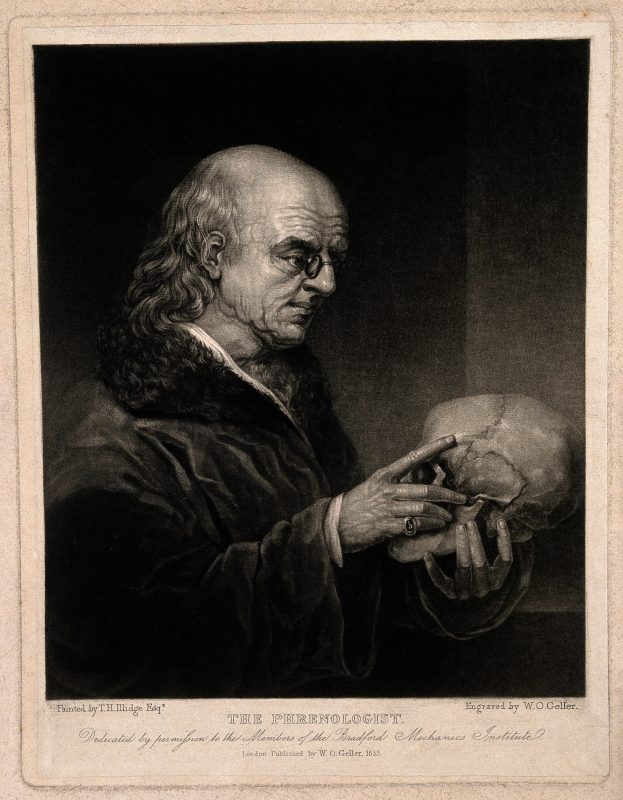
Credit: Wellcome Library, London. Wellcome Images
In the Regency era, phrenology—the study of the shape and size of the skull to determine personality traits and mental abilities—captivated the public’s imagination. Though now discredited as a pseudoscience, phrenology was taken seriously by many during the early 19th century. It reflected the era’s fascination with science, self-improvement, and the idea that human behaviour could be understood and categorised.
The Origins of PhrenologyPhrenology was developed by German physician Franz Joseph Gall in the late 18th century. Gall proposed that the brain was divided into distinct regions, each responsible for a specific trait or faculty, such as intelligence, morality, or aggression. He argued that the size of these regions could be determined by examining the shape of the skull, with bumps and contours indicating the strength or weakness of particular traits.
By the Regency era, phrenology had spread to Britain, where it was popularised by figures like George Combe. It appealed to the public’s growing interest in science and self-knowledge, as well as the era’s emphasis on individualism and self-improvement.
The Practice of Phrenology

Phrenologists would examine a person’s skull by feeling its contours and measuring its dimensions. They would then produce a detailed analysis of the individual’s character, talents, and potential. Phrenology was used for a variety of purposes, from guiding career choices to assessing criminal behaviour.
Phrenology also had a commercial side. Phrenologists offered private consultations, published books and charts, and even sold plaster casts of skulls for study. The practice became a popular form of entertainment, with public lectures and demonstrations drawing large crowds.
The Social Implications of Phrenology
Phrenology reflected and reinforced the social hierarchies of the Regency era. Proponents claimed that certain racial and gender differences could be identified through skull measurements, often using these findings to justify existing prejudices. For example, phrenologists argued that women’s skulls indicated a natural predisposition toward nurturing and submissiveness, while men’s skulls suggested rationality and leadership.
At the same time, phrenology also offered a sense of empowerment. By understanding their own strengths and weaknesses, individuals could work to improve themselves and achieve their full potential. This idea resonated with the era’s emphasis on self-help and personal development.
The Decline of Phrenology
By the mid-19th century, phrenology began to lose credibility as scientists developed a better understanding of the brain and its functions. Critics argued that phrenology was based on flawed assumptions and lacked empirical evidence. However, its influence persisted in fields like psychology and criminology, where the idea of linking physical traits to behaviour continued to hold sway.
Conclusion
Phrenology offers a fascinating glimpse into the scientific and cultural trends of the Regency era. While it may seem strange or even absurd today, it reflected the era’s optimism about the power of science to unlock the secrets of human nature. Its legacy serves as a reminder of the dangers of pseudoscience and the importance of critical thinking.
References for Further Reading:
- Phrenology
https://en.wikipedia.org/wiki/Phrenology - Why Was Phrenology All the Rage in Victorian Times?
https://science.howstuffworks.com/life/inside-the-mind/human-brain/phrenology.htm

Leave a Reply